


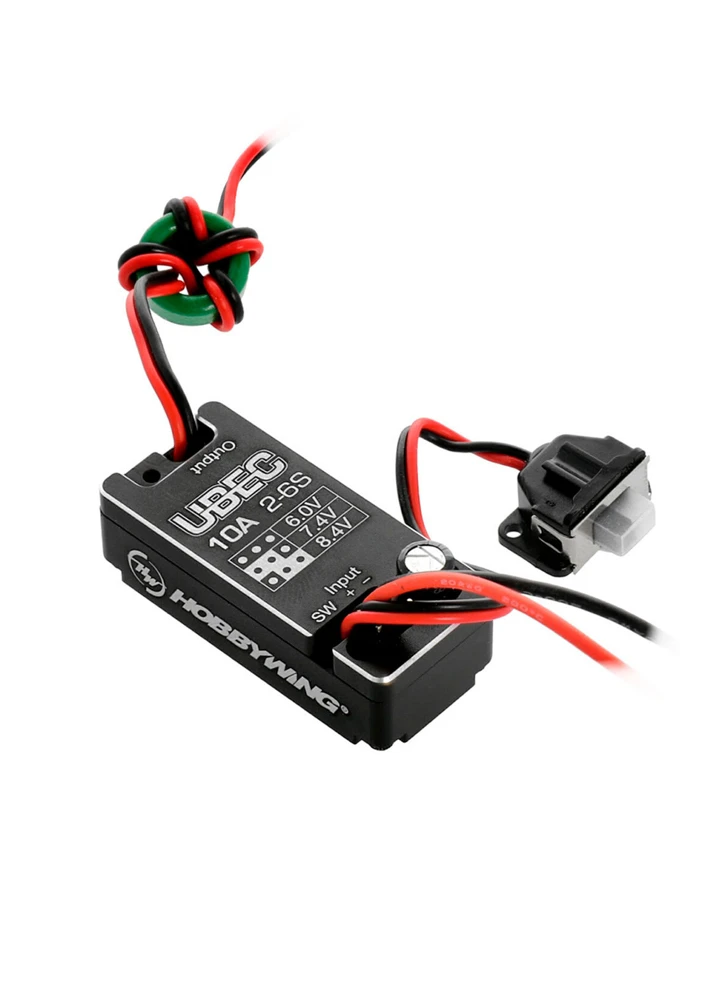
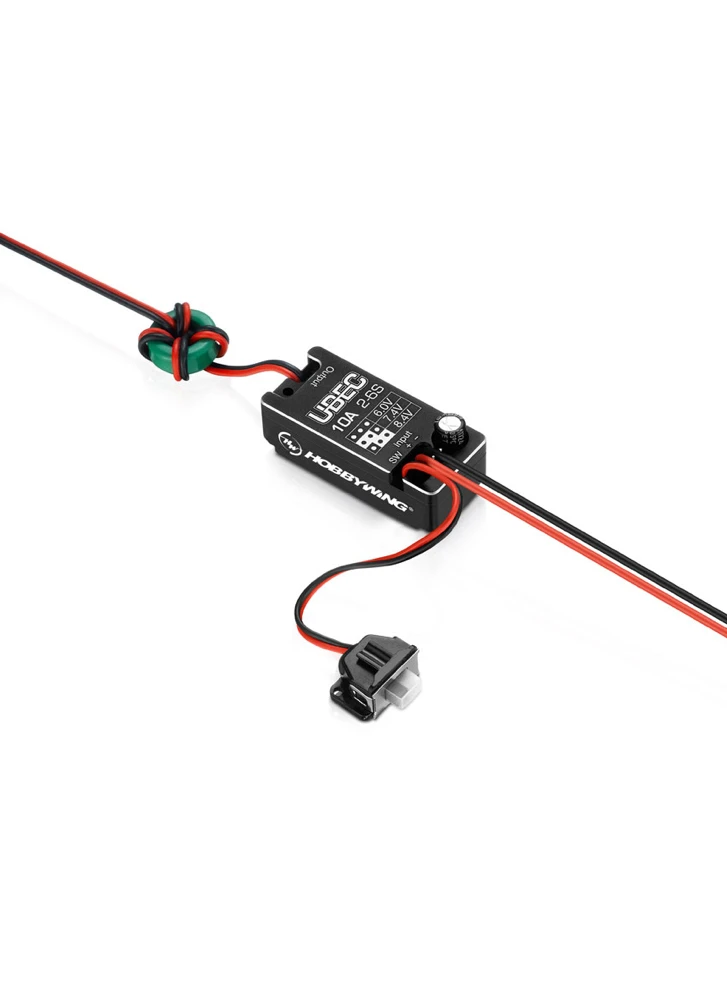
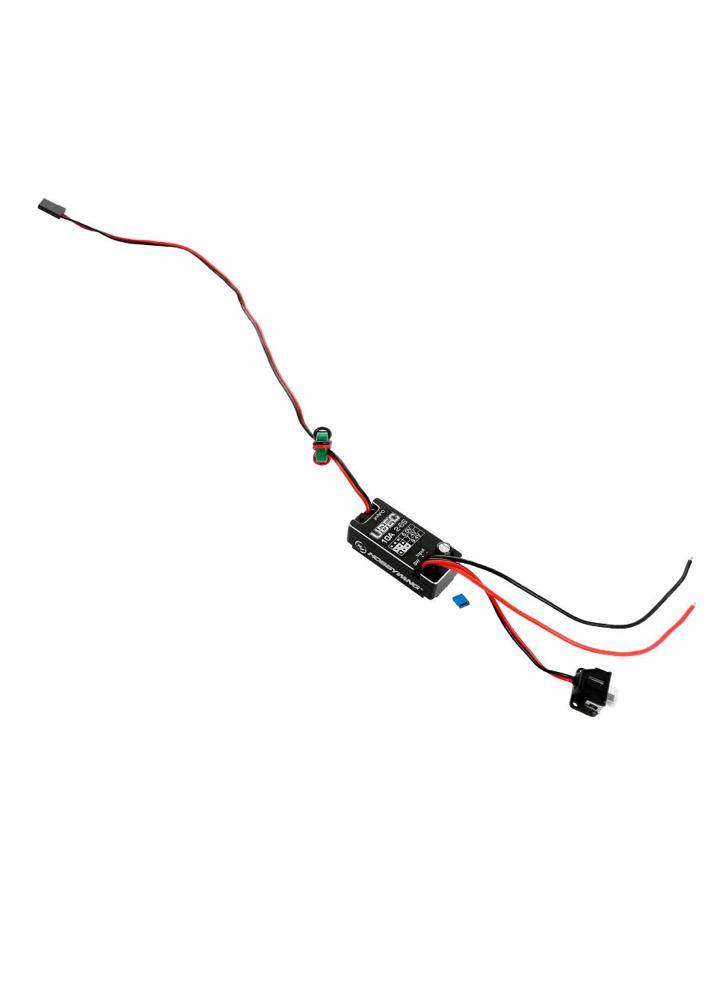


Hobbywing 10A 2-6S UBEC with 6.0V/7.4V/8.4V Output
£29.99 Inc. VAT
The UBEC is not only powerful, but also waterproof and dust proof (IP67), making it particularly suitable for RC cars.
Only 2 left in stock|Next shipping: 20/03/2026
The UBEC is an external switching mode DC-DC regulator; it draws the DC voltage from 2-6S Lipo battery and drops it to a voltage level that is suitable for receivers and other electronic devices (6.0V-8.4V). It provides a very stable output current, rated at 10Amps / 15Amps burst.
The output voltage is programmable via a header pin jumper – 3 output voltages: 6.0V/7.4V/8.4V. It is also switchable: On/Off.
The UBEC is not only powerful, but also waterproof and dust proof (IP67), making it particularly suitable for RC cars.
Features:
- Highly efficient DC-DC regulator chip for a transmission efficiency of over 90%.
- An all-metal housing design helps conduct heat and reduces electromagnetic interference.
- Adjustable UBEC output voltage (6.0V / 7.4V / 8.4V) applicable for servos with different voltages.
- The continuous current of UBEC is up to 10A and max. 15A and can thus be used for various electrical devices (e.g. car lights, winches, windshield wipers, etc.).
- Excellent waterproof and dustproof design with IP67 rating.
- Multiple protection functions: overcurrent protection, output short circuit protection, overheating protection, safe and reliable.
- External switch enables the UBEC to be switched on / off easily.
- LED display to show the status of the UBEC.
- Input voltage: 2-6S lithium batteries
- Output voltage: 6.0 / 7.4 / 8.4 V (3 options adjustable)
- Output current: Continuous 10A / Instantaneous 15A
- Measurement: 45x20x16.2mm
- Weight: 34g (including wires
Questions and answers of the customers
There are no questions yet. Be the first to ask a question about this product.
Learn about voltage regulation: Supplying your electrical components with the correct voltage is crucial for their operation. LiPo battery cells are rated at 3.7 volts per cell, therefore a range of voltages are available, leading from 3.7v (1S) to 44.4v (12S). A 3 cell 11.1v pack is widely employed as it provides a handy voltage for many electronics without the need to regulate. However, more powerful multirotors require LiPos with greater voltages; 6S (22.2v) is common for octocopters, thus voltage regulation is necessary to supply power to auxiliary components, such as the: receiver, flight controller, camera, transmitter and lights etc.
There are two types of regulators, linear and switching. A linear regulator works by taking the difference between the input and output voltages, and just burning it up as waste heat. The larger the difference between the input and output voltage, the more heat produced. This is the reason why linear regulators are usually only compatible with up to 3S LiPos. Linear regulators typically operate with efficiencies of 40%, reaching as low as 14%. On the other hand, switching regulators are far more efficient. They work by storing pulses of energy taken from the battery in a capacitor and then releasing it. This is accomplished with the help of an electrical switch and a controller, which regulates the rate at which energy is transferred to the output (hence the term “switching regulator”). The energy losses involved in moving chunks of energy around in this way are relatively small, and the result is that a switching regulator can typically have 85% efficiency. Since their efficiency is less dependent on input voltage, they are compatible with higher voltage LiPos. While they are preferable to linear regulators you should consider their placement within the UAV carefully, as in some cases the switching noise can cause interference with the receiver.
Within a multirotor context, the term “BEC” (Battery Eliminator Circuit) is exchangeable with voltage regulator. The use of a BEC negates the traditional need for a separate battery to power you flight auxiliaries, for example a receiver. Most speed controllers (Not OPTO ESCs) incorporate an internal 5v linear BEC, so that simply plugging the ESC into the receiver is all you need to supply power to it. However, as mentioned above they only work well under low loads and at low voltages. For higher voltage/current applications it is recommended to use a stand-alone SBEC – that way you reduce the risk of a brownout (a term used to describe the temporary loss of function of the radio receiver due to the supply voltage dropping too low). Confusion often surrounds the difference between a UBEC and an SBEC, however they are both the same thing – a switching voltage regulator. “UBEC” was once a specific brand name for one of the original switching BECs, so the more correct generic term is actually SBEC.
SHIPPING & DELIVERY
We are based in the UK and ship to most destinations worldwide.
We dispatch orders during the times shown on our Dispatch Schedule. Orders placed before the daily dispatch cutoff will ship the same day (subject to stock availability). Orders placed after the cutoff will ship on the next scheduled dispatch day.
A confirmation email is sent once your order has been packed. If you need to amend your order, please contact us as soon as possible — once shipped, we’re unable to make changes.
We work with trusted delivery partners including Royal Mail, DHL, UPS, Fedex and Parcelforce. If you have a delivery requirement or would like to arrange collection, please get in touch.


Next Dispatch: Tomorrow
Please fill in the fields below with the shipping destination details in order to calculate the shipping cost.
Shipping to the UK
- Order before the daily dispatch cutoff for same day dispatch.
- FREE delivery available on qualifying orders over £99 (under 1kg).
For small, low-value orders, Royal Mail First Class is our most economical option. Royal Mail Tracked 24 is the most popular choice, offering full tracking and flexible delivery options. For guaranteed next working day delivery, we recommend Royal Mail Special Delivery.
Royal Mail delivers to residential addresses Monday to Saturday, while courier services (including DHL) typically deliver Monday to Friday.
International Postage
- USA orders: Import duties and taxes are prepaid by us — no additional customs charges on delivery.
- Other destinations: Customs duties or import taxes may apply and are the responsibility of the recipient.
Smaller, lower-value orders may be sent via Airmail or tracked postal services. Economy road and express air courier options are available depending on destination. For faster delivery, we recommend express air courier services such as DHL Express, which typically deliver within 1–2 working days across Europe and a few working days for most other destinations.
You may also like…


Related products






Reviews
Clear filtersThere are no reviews yet.